
Parlays: Why the Payouts Look So Good, and When They're Actually Worth It
Multiplying odds multiplies excitement and house edge at the same time. A clear-eyed look at everyone's favorite bet.
 By Nolan Gaffney · Founder, LeagueLocks · Aug 8, 2026 · Updated Sep 12, 2026 · 8 min read
 Bet Types
A parlay chains two or more bets into one ticket: every leg must win, and the odds multiply. Two −110 legs become roughly +264. Add a third and you're near +595. The appeal is obvious, small stake, big number, maximum sweat.
The math the big number hides
Multiplying odds also multiplies the juice. One −110 bet needs 52.4% to break even. A two-leg parlay of −110 bets pays +264, but fair odds for two true coin flips would be +300, the gap is the book's edge, compounding with every leg you add. Long-term, parlays give the house a bigger cut than the same bets made separately.
So why bet them at all?
Because leagues don't only optimize for expected value, they optimize for the sweat. One ticket that needs the Panthers AND the under creates a two-act drama the whole group chat lives through together. For a crew betting a shared pool, an occasional parlay is entertainment spend, and knowing that is what separates a sharp league from a degenerate one.
Correlation: the one smart parlay trick
Some legs rise and fall together. A quarterback's over on passing yards correlates with his team's over; a heavy favorite covering correlates with the under in a blowout-and-kneel script. Books ban or reprice the strongest correlations (same-game parlays carry extra juice for exactly this reason), but thinking in correlated stories, 'if this game goes how we think, both legs hit', is how experienced bettors build parlays that are less bad than random ones.
What the house actually keeps
The clearest evidence that parlays favor the book isn't theory, it's the books' own accounting. Nevada sportsbooks, which report revenue by bet type, historically hold around 30% of every dollar wagered on parlay-style bets, versus roughly 5% on straight football bets. Same games, same bettors, six times the house cut, purely because of how the ticket is constructed. Sportsbooks put parlay promos on the front page of the app for the same reason casinos put slot machines by the door. None of this makes an occasional parlay wrong for a crew that knows the price of the fun, it makes an every-week parlay habit a donation schedule.
A three-leg ticket, priced honestly
Put numbers on one. Three -110 legs, $20 stake, payout about +595, $139 total back. If each leg is a true coin flip against the spread, the ticket wins 52.4% cubed: about 14.4% of the time. Fair odds on a 14.4% shot are +595... minus the rounding the book keeps, true fair value is closer to +633. The gap between what you're paid and what the probability deserves is the compounded vig, and it widens with every leg. The takeaway isn't 'never parlay.' It's that a parlay is priced like a convenience product: you're paying extra for the packaging. Sometimes the packaging, one ticket, one sweat, one screenshot, is worth it. Just know you're buying it.
Same-game parlays: the fun tax, itemized
The same-game parlay is the industry's fastest-growing product, and it's priced accordingly. Because legs from one game genuinely correlate, a QB's passing yards, his top receiver's catches, and the game total all move together, books can't just multiply the odds, so they run SGPs through pricing models that shave the payout hard. Independent analyses consistently find SGP holds well above even standard parlay holds. The correlated story ('this game shoots out, so all three overs hit') is real handicapping logic; the price you're offered for it is the worst on the menu. If your crew loves the SGP sweat, size it small and treat the discount as the cost of the show.
House rules for league parlays
Three suggestions for crews: cap parlays at two or three legs (the fun-per-leg curve flattens fast while the edge keeps compounding); treat them as a change-up, not the weekly default; and never chase a losing streak with a longshot ticket, that's the classic bankroll killer. Your league's weekly wager is sized to survive variance. Keep it that way.
Play responsibly. If gambling stops being fun, call or text 1-800-GAMBLER.
Sources are linked where they're used in the article above. Stats and lines are as reported by the cited outlets at publish time. LeagueLocks is not affiliated with the NFL or any team.
Comments
Loading…
Keep reading
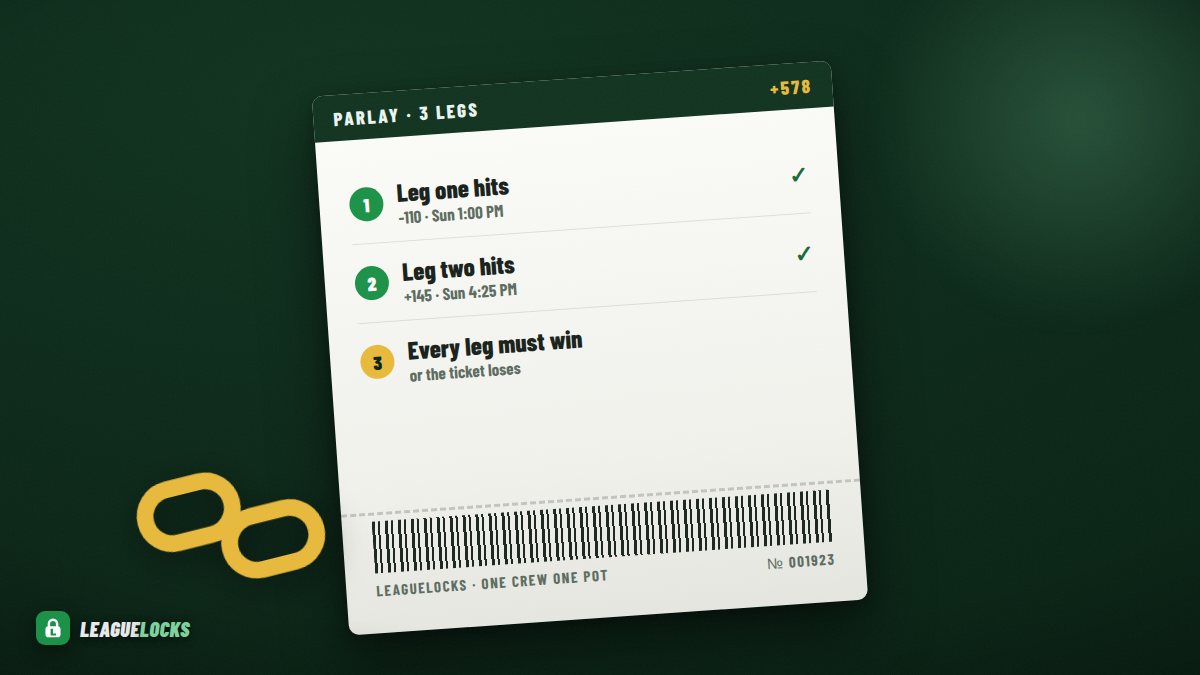
How to Build the Perfect Parlay (Or at Least Stop Building Terrible Ones)
Parlays are how books print money, and how crews have the most fun. The fix isn't avoiding them. It's knowing the math, capping the legs, and building around one thesis instead of five vibes.
Aug 24, 2026 · 7 min read

Week 5's Injury Fallout: Philadelphia Is Out of Running Backs, Penix's Ribs, and the Lamar Watch Rolls On
Will Shipley scored a touchdown and then tore his plantar fascia, making him the third Eagles back down in 15 days. Plus Michael Penix's ribs, T.J. Hockenson's concussion, Deebo Samuel's hamstring, and a surprisingly crowded good-news column.
Oct 14, 2026 · 8 min read

Week 5 Stock Report: Maye Keeps Climbing, Allen Ran Through Los Angeles, and Chicago Fell Apart Without a Quarterback
Drake Maye hung 374 and four scores on the Raiders, Josh Allen ran for 121 on Sunday night, Bucky Irving made us eat a take, and the Bears, Chargers, and Cowboys all left Week 5 with real problems. Who impressed, who didn't, and which of it is real.
Oct 14, 2026 · 8 min read
Week 6 Waiver Wire: Philly's Last Back Standing, the Bernard Takeover, and a Tank Dell Lottery Ticket
Dameon Pierce became an NFL starting running back by process of elimination. Plus the rookie who took Roman Wilson's job in one afternoon, CeeDee Lamb insurance, two tight ends with real roles, and a famous name practicing again in Houston.
Oct 14, 2026 · 7 min read