
How to Build the Perfect Parlay (Or at Least Stop Building Terrible Ones)
Parlays are how books print money, and how crews have the most fun. The fix isn't avoiding them. It's knowing the math, capping the legs, and building around one thesis instead of five vibes.
 By Nolan Gaffney · Founder, LeagueLocks · Aug 24, 2026 · Updated Sep 12, 2026 · 7 min read
 Bet Types
Every league chat has one: the six-leg parlay screenshot with a five-figure payout that died at 7:31 on Sunday night. Parlays are the most-mocked bet in football and the most-placed. Both are earned. Here's how the pricing actually works, why most parlays are bad, and how to build one you can defend when the league votes on it.
The math the ticket doesn't show you
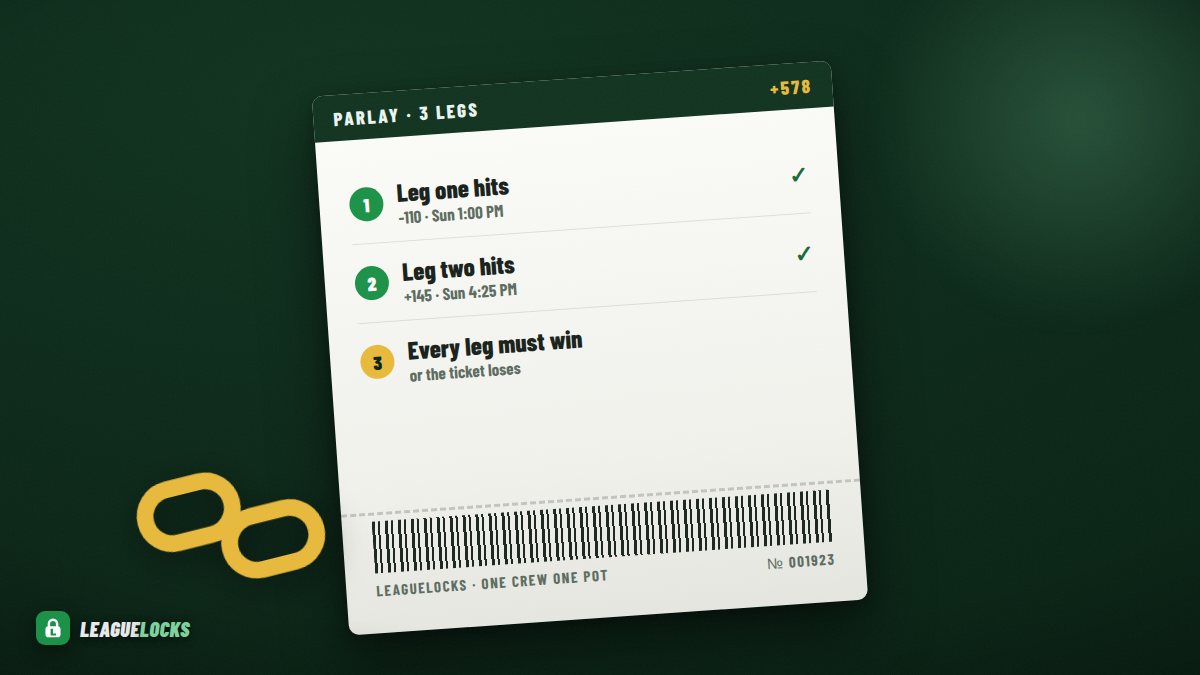
A parlay multiplies your odds, and your risk, leg by leg. Two standard -110 bets each win about 52.4% of the time if they're coin flips against the spread. Together: 52.4% × 52.4% ≈ 27.5%. Fair odds on a 27.5% shot would be about +264, and +264 is roughly what a two-leg parlay of -110s pays. Sounds fine, until you notice what compounded: the book's cut. The vig you pay on one leg gets baked into every leg, so the house edge grows with each addition. By six legs of -110, you're getting paid around +4700 for something whose fair price is closer to +5500. The more legs, the more of your payout the book quietly keeps.
Rule 1: cap it at two or three legs
Every leg roughly halves your chance of cashing. Two legs win about a quarter of the time. Three legs, about one in seven. Four legs, one in fourteen. Anything past three isn't a bet, it's a lottery ticket with worse art. If your crew's weekly wager is meant to actually grow the prize pool over a season, two or three legs is the ceiling, which is why LeagueLocks caps proposed picks at +2000 odds. A cap isn't a buzzkill; it's what keeps the pot alive past October.
Rule 2: build around one thesis, not five hunches
The best parlays are one opinion expressed twice, not five opinions stapled together. If you believe a game stays low-scoring because both starting quarterbacks are sitting, then under-the-total plus the better defense's team total under is one coherent thesis. If you believe a home favorite rolls, the favorite's spread plus their star's over on rushing yards moves together. When legs are correlated, when one hitting makes the other likelier, the true odds of the combo are better than the multiplied price suggests. Books know this too, which is why same-game parlays get repriced, but correlation is still the closest thing to an edge a parlay ever has. Five unrelated legs across five games is the opposite: pure multiplied vig.
Rule 3: never parlay heavy favorites for a 'safe' boost
The classic trap: stack four -400 moneyline favorites to manufacture a +150 payout. It feels safe, every leg is 'sure.' The math disagrees: four 80% legs win just 41% of the time, and you're being paid like it's 40% while the book pockets the difference on each leg. One upset, and there's an upset every single week of an NFL season, torches the ticket. If you want +150, bet one thing priced at +150. Same payout, one point of failure instead of four.
Rule 4: size it like entertainment, because it is
Even a well-built three-leg parlay loses most weeks. That's fine if it's priced into how you play: a small, fixed stake, the same every week, never chased after a loss, from a bankroll you'd spend on a night out. For a crew, that's exactly what the weekly wager should be: an amount that makes Sunday loud and Monday painless. The parlay isn't the retirement plan. It's the group chat's plot device.
The crew checklist
Before you propose a parlay to your league: Can you say the thesis in one sentence? Is it three legs or fewer? Is every leg something you'd bet on its own? Is the combined price under your league's odds cap? Would you still like the ticket if a stranger proposed it? Five yeses and it's a defensible pick. Anything less, and the chat will do what chats do.
Play responsibly. If gambling stops being fun, call or text 1-800-GAMBLER.
Sources are linked where they're used in the article above. Stats and lines are as reported by the cited outlets at publish time. LeagueLocks is not affiliated with the NFL or any team.
Comments
Loading…
Keep reading

Parlays: Why the Payouts Look So Good, and When They're Actually Worth It
Multiplying odds multiplies excitement and house edge at the same time. A clear-eyed look at everyone's favorite bet.
Aug 8, 2026 · 8 min read
Week 5's Injury Fallout: Philadelphia Is Out of Running Backs, Penix's Ribs, and the Lamar Watch Rolls On
Will Shipley scored a touchdown and then tore his plantar fascia, making him the third Eagles back down in 15 days. Plus Michael Penix's ribs, T.J. Hockenson's concussion, Deebo Samuel's hamstring, and a surprisingly crowded good-news column.
Oct 14, 2026 · 8 min read

Week 5 Stock Report: Maye Keeps Climbing, Allen Ran Through Los Angeles, and Chicago Fell Apart Without a Quarterback
Drake Maye hung 374 and four scores on the Raiders, Josh Allen ran for 121 on Sunday night, Bucky Irving made us eat a take, and the Bears, Chargers, and Cowboys all left Week 5 with real problems. Who impressed, who didn't, and which of it is real.
Oct 14, 2026 · 8 min read
Week 6 Waiver Wire: Philly's Last Back Standing, the Bernard Takeover, and a Tank Dell Lottery Ticket
Dameon Pierce became an NFL starting running back by process of elimination. Plus the rookie who took Roman Wilson's job in one afternoon, CeeDee Lamb insurance, two tight ends with real roles, and a famous name practicing again in Houston.
Oct 14, 2026 · 7 min read