
Overreaction Season Is Here: What a Week 1 Result Actually Predicts (With Ten Years of Numbers)
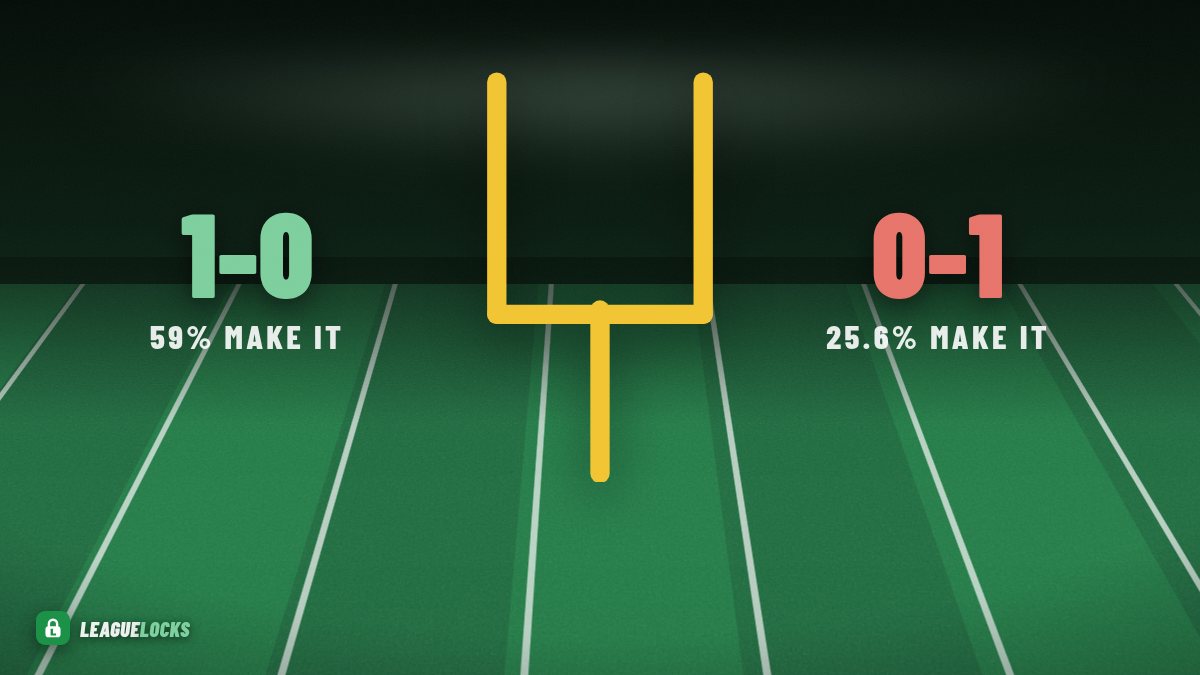
Teams that win their opener make the playoffs 59% of the time; teams that lose it, 25.6%. That gap is real, and it's also exactly why the week after the opener is the most expensive week of the year to have opinions. Here's how to read Week 1 without getting played by it.
 By Nolan Gaffney · Founder, LeagueLocks · Sep 3, 2026 · 7 min read
 Season Strategy
Sometime around 4:30 p.m. next Sunday, half your league chat will be declaring seasons over and the other half will be planning parades. Week 1 overreaction is a ritual older than fantasy football itself. What's newer is that we can actually measure how much one game means, RotoWire ran every season from 2016 through 2025, and the answer is: more than the 'it's just one game' crowd says, and much less than your group chat will claim.
The real numbers
Over the last decade, teams that started 1-0 made the playoffs 59.0% of the time. Teams that started 0-1 made it 25.6% of the time. That's a 2.3× multiplier from a single game, and it runs all the way down the bracket: 1-0 teams won their division at 35.3% (vs. 16.0%), reached the conference championship at 19.2% (vs. 6.4%), and won the Super Bowl at 4.5% (vs. 1.9%). One detail worth pinning: road wins predicted better than home wins, Week 1 road winners made the playoffs 61.5% of the time. Winning a real game in someone else's building is evidence; defending your own on opening day is closer to expectation.
Why one game carries that much signal
It's not that Week 1 causes anything. It's selection: good teams win openers because they're good, and the opener is simply the first time the market gets graded. Some of the gap is also schedule math, an 0-1 team needs to outplay its own record the rest of the way, in a league where 9-8 sometimes makes the field and 10-7 sometimes misses. The result that should move your priors most is the one that came with an explanation you didn't have in August: a rebuilt offensive line that got shoved around, a new quarterback who looked processed, a defense that couldn't get off the field.
What it means for your fantasy roster
The same logic, miniaturized. A Week 1 dud from a proven veteran in a good offense is noise, sell nothing, and if a panicking manager wants to move him at a discount, that's your buy window. What IS signal after one week: snap counts, target shares, and red-zone roles. A running back who played 30% of snaps behind the guy you drafted him over didn't have a bad game, he has a bad job. Usage is real after one week; stat lines mostly aren't. And on waivers, September is where FAAB budgets go to die, before you bid on Sunday's hero, ask whether his role changed or just his highlight reel.
What it means for your league's bets
For a betting crew, the trap is symmetrical. The market overreacts to Week 1 blowouts in both directions, the team that lost ugly gets too cheap by Wednesday, the team that won pretty gets too expensive. Ten years of playoff data says respect the result; the same data's fine print says the number moved further than the evidence did. The best Week 2 picks usually live in that gap: the 0-1 team getting extra points because everyone watched them lose, backed by a reason to think the loss was circumstance rather than identity.
The one-sentence version
Take Week 1 seriously as evidence and lightly as verdict: update on what you saw, not on what the scoreboard felt like, and let everyone else in your league do the overreacting.
Play responsibly. If gambling stops being fun, call or text 1-800-GAMBLER.
Sources are linked where they're used in the article above. Stats and lines are as reported by the cited outlets at publish time. LeagueLocks is not affiliated with the NFL or any team.
Comments
Loading…
Keep reading

Week 5's Injury Fallout: Philadelphia Is Out of Running Backs, Penix's Ribs, and the Lamar Watch Rolls On
Will Shipley scored a touchdown and then tore his plantar fascia, making him the third Eagles back down in 15 days. Plus Michael Penix's ribs, T.J. Hockenson's concussion, Deebo Samuel's hamstring, and a surprisingly crowded good-news column.
Oct 14, 2026 · 8 min read

Week 5 Stock Report: Maye Keeps Climbing, Allen Ran Through Los Angeles, and Chicago Fell Apart Without a Quarterback
Drake Maye hung 374 and four scores on the Raiders, Josh Allen ran for 121 on Sunday night, Bucky Irving made us eat a take, and the Bears, Chargers, and Cowboys all left Week 5 with real problems. Who impressed, who didn't, and which of it is real.
Oct 14, 2026 · 8 min read
Week 6 Waiver Wire: Philly's Last Back Standing, the Bernard Takeover, and a Tank Dell Lottery Ticket
Dameon Pierce became an NFL starting running back by process of elimination. Plus the rookie who took Roman Wilson's job in one afternoon, CeeDee Lamb insurance, two tight ends with real roles, and a famous name practicing again in Houston.
Oct 14, 2026 · 7 min read

The Trends Through Five Weeks: Five More Outright Dogs, Four Home Favorites Down, and the Board Even Tied One
Winless Tampa Bay won in Dallas, the 5-0 Niners won as dogs in Seattle, Baltimore won in Atlanta with a backup, both monster totals sailed over, and Washington and the Giants played to the season's first tie. The five-week ledger, and how last week's angles graded out.
Oct 14, 2026 · 8 min read